Bespoke vs made to measure is the question we hear most often across the cutting table, usually right after “how long will it take?”. Both words appear on shop windows all over Saigon, and both promise a suit that fits. They are not the same thing.
The difference is not about price or about how fancy the shop looks. It is about where the suit starts, who measures you, how many times it is fitted on your body and how much is changed along the way.
This guide explains both clearly, adds the two terms people often confuse with them, and gives you simple questions to ask any tailor. By the end, you will know which one you actually need.
The short answer
- Made to measure: a standard pattern is adjusted to your measurements. Usually one fitting, or none.
- Bespoke: the suit is cut for you from the start and shaped on your body over fittings.
- The real difference: how far the suit can move away from the average body, and how many times someone checks it on you.
- Which to choose: made to measure for an average build and a tight budget; bespoke for posture, unusual proportions or very particular taste.
- At ManGii: every order is cut for your shape and fitted twice, in about two weeks (about three for full canvas).
Table of Contents
What is the difference between bespoke vs made to measure?
In the bespoke vs made to measure debate, the shortest honest answer is this: made to measure adjusts, bespoke builds. Everything else follows from that.
A made to measure suit starts from a set of standard block sizes. The maker takes your measurements, picks the closest block, and lengthens a sleeve here or lets out a waist there. The shape underneath stays the shape of the block.
A bespoke suit starts from you. The cutter reads your measurements together with how you stand, the slope of your shoulders and the way you move, and cuts the cloth for that body. Then the suit is fitted on you and changed until it sits right.
| Made to measure | Bespoke | |
|---|---|---|
| Starting point | A standard block, adjusted | Cut for your body |
| Fittings | Usually none or one | Two or more |
| Posture and shape | Small corrections | Built in from the start |
| Construction | Often fused or half canvas | Your choice, up to full canvas |
| Style options | A menu of set options | Wide, discussed with the cutter |
The tradition of bespoke tailoring comes from London’s Savile Row, where the word originally meant cloth that had been “spoken for” by a client. The idea has not changed: the suit belongs to one person from the first cut.
Where do ready-to-wear and made to order fit in?
Two more terms often sit next to these, and they add to the confusion. Here is the whole ladder, from the least personal to the most.
| Type | How it is made | Fit |
|---|---|---|
| Ready-to-wear | Standard sizes, made in advance | Off the rack, altered after |
| Made to order | A standard size, made once you order it | Your choice of cloth, standard fit |
| Made to measure | A standard block adjusted to your numbers | Closer, within the block’s limits |
| Bespoke | Cut for one body, fitted on it | As close as your body and taste allow |
Made to order is the one people often mistake for made to measure. You choose the cloth and some details, but the size is still a standard size. It can look personal and fit like ready-to-wear.
What does a bespoke suit change in the fit?
A bespoke suit is cut for your body, so it handles the things a standard block cannot. Most people have at least one of them, even if they have never noticed.
- One shoulder lower than the other. Very common, especially in people who carry a bag on one side.
- A forward or upright posture. It changes the length of the back and the balance of the front.
- Sloping or square shoulders. It decides how much padding you need and where the collar sits.
- A strong seat or thighs. Trousers need more room behind without extra cloth in front.
- Different arm lengths. Often a centimetre or more.
Made to measure can correct some of these with small changes to the block. A bespoke suit builds them in from the first cut, which is why the collar stays close to the neck and the back stays clean when you move.
Why do fittings matter so much?
Numbers on paper never tell the whole story. A body measured standing still behaves differently when it walks, sits and reaches for a glass.
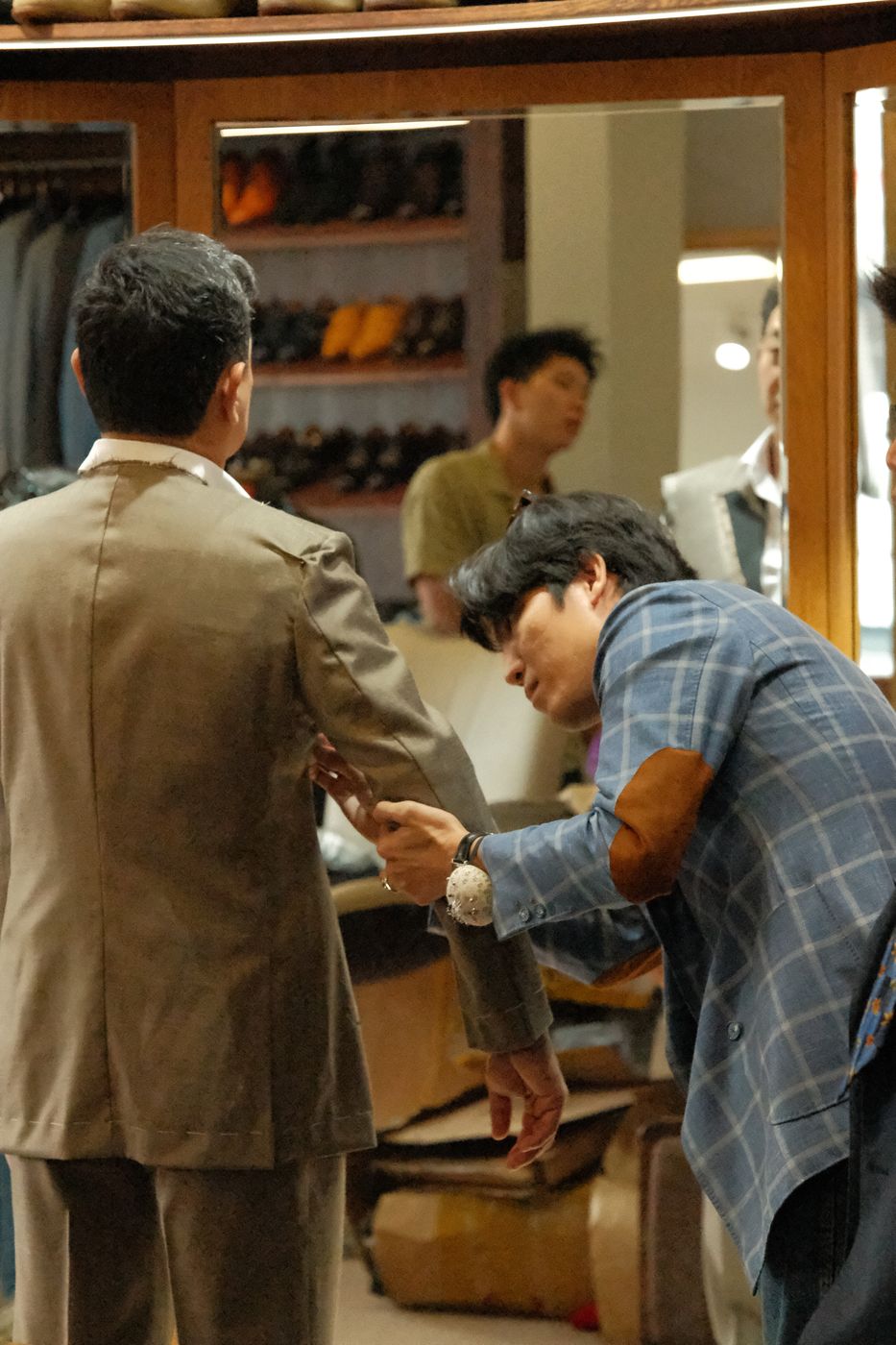
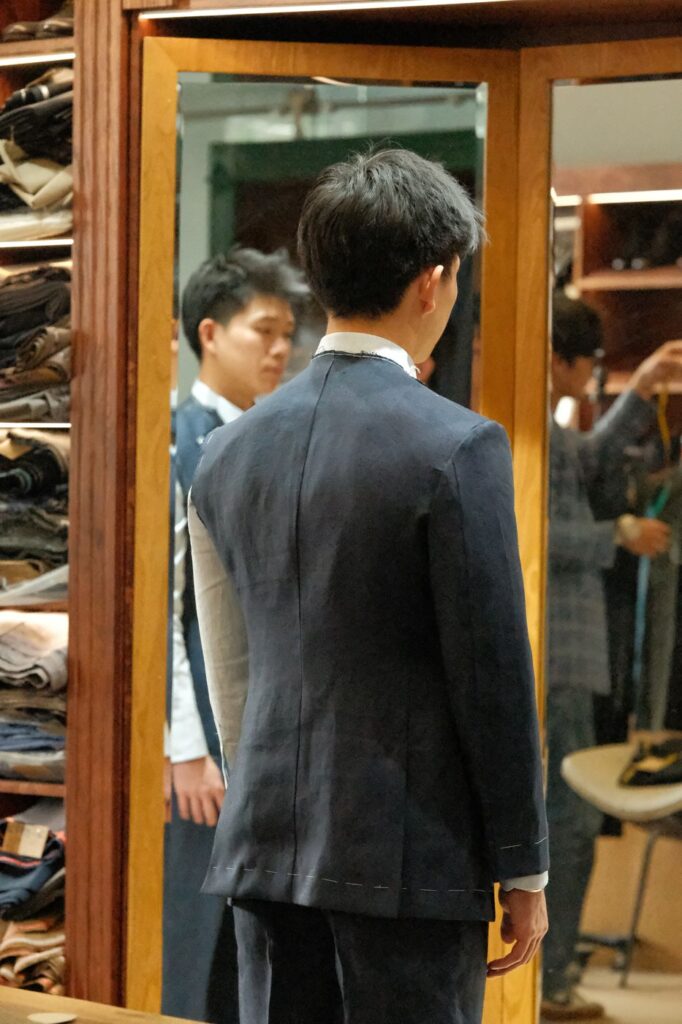
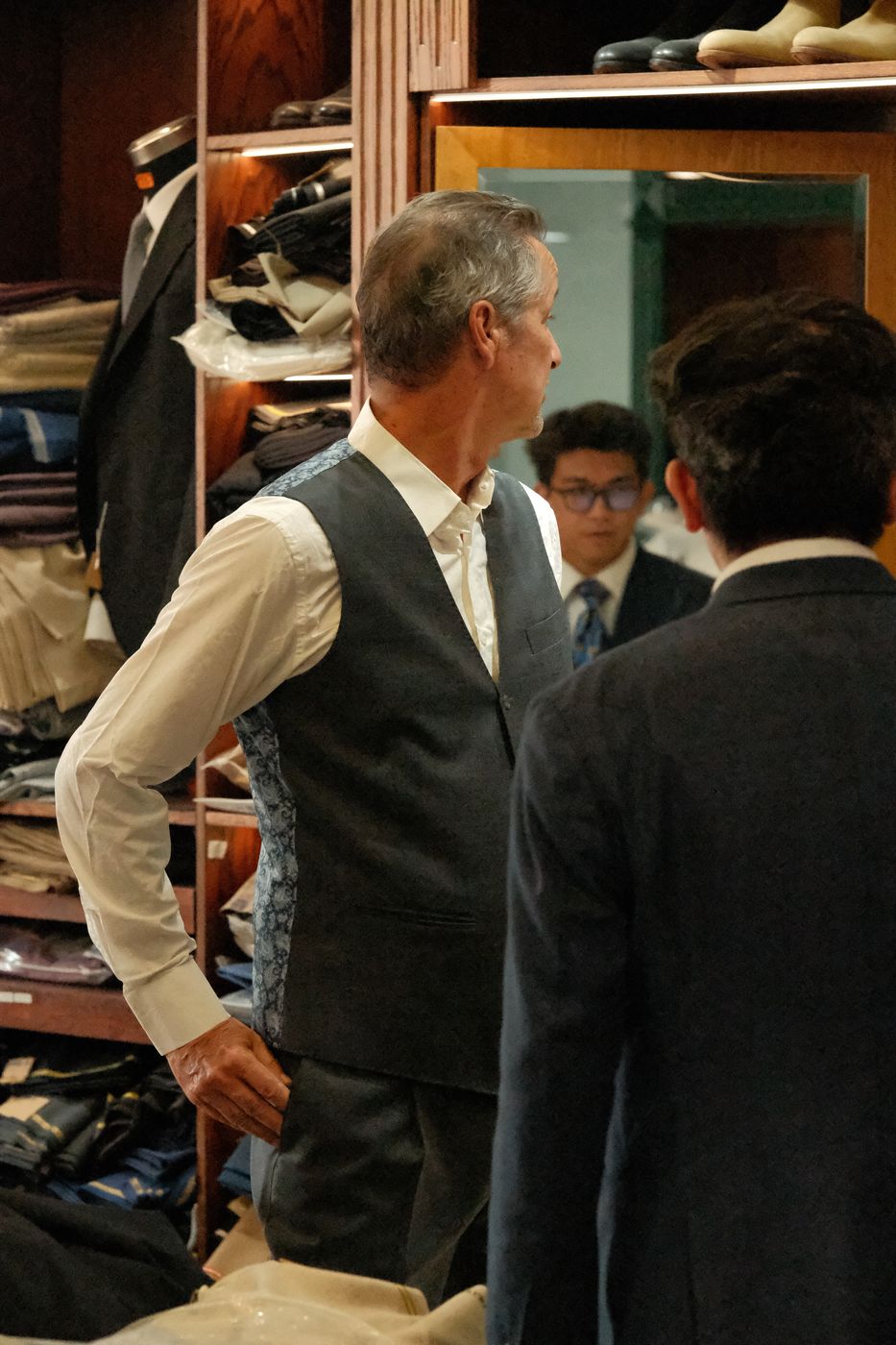
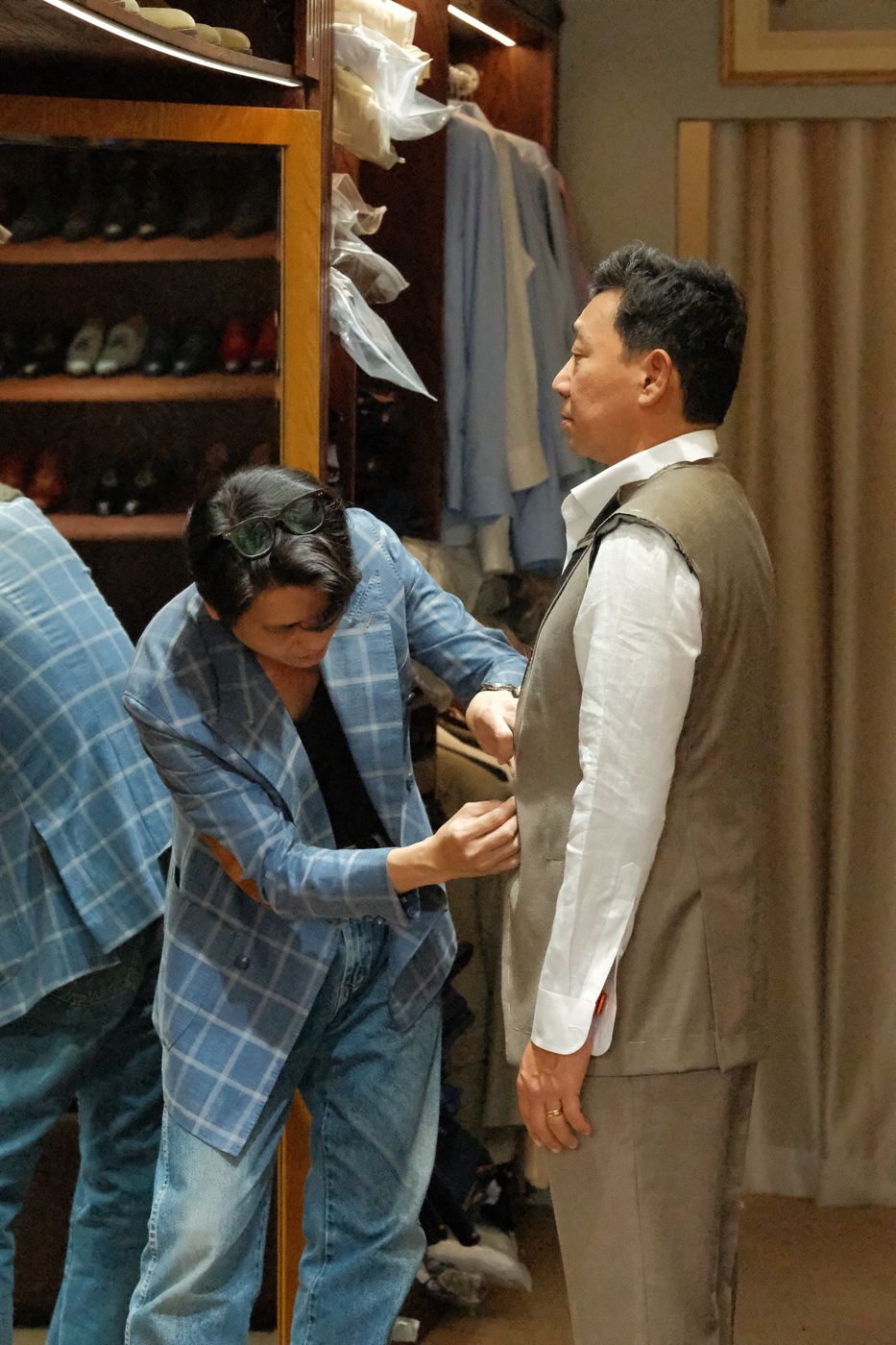
At a fitting, the tailor sees where the cloth pulls, folds or stands away from your body. Then they chalk, pin and change it, which no measurement sheet can do.
This is the clearest line in bespoke vs made to measure. A made to measure suit is usually finished before you see it. A bespoke suit is shaped on you while there is still time to change it.
Our guide on how long a bespoke suit takes walks through what happens at each of our two fittings.
How does construction differ?
Construction is the hidden structure inside the jacket front. It affects how the suit drapes and how long it keeps its shape.
- Full canvas: a layer of canvas runs through the whole front and is stitched in. It shapes to your chest over time.
- Half canvas: canvas in the chest and lapel, a fused layer below. A good balance of shape and weight.
- Fused: a layer is bonded to the cloth. Light, quicker to make, and high-quality fusing keeps its shape well.
Made to measure suits are often fused or half canvas, because the process is built for speed. A bespoke suit lets you choose. At ManGii we make all three, and we help you choose based on how and where you will wear the suit.
Bespoke suit or custom suit: what is the difference in cost?
A custom suit can mean either, so the label tells you little about cost. What you pay for is cloth, construction and time, including the time spent fitting you.
In bespoke vs made to measure pricing, made to measure is usually lower because it uses standard blocks and skips most fittings. A bespoke suit costs more because a cutter works on your body, and the suit is changed after each fitting.
At ManGii, two-piece suits start from 7,700,000 VND and three-piece suits from 9,600,000 VND. Two-piece suits in 100% wool start from 16,500,000 VND. We have many cloths for many budgets, and we will tell you plainly where extra money changes the result.
Which one should you choose?
When it comes to bespoke vs made to measure, neither is right for everyone. Here is how we would think about it if we were in your shoes.
| Choose | If you | Good for |
|---|---|---|
| Made to measure | Have an average build and want a decent fit quickly | Spare suits, uniforms, tight budgets |
| Bespoke | Have posture or shape differences, or know exactly what you like | Daily suits, weddings, suits to keep for years |
If you have struggled with off-the-rack jackets, if one shoulder sits lower, or if you want particular details, bespoke will make the bigger difference. If you fit standard sizes well and need a simple suit, made to measure can be enough.
How can you tell what you are really getting?
Many shops use the words bespoke vs made to measure loosely, so ask questions instead of reading labels. A good tailor will answer them directly.
- How many fittings will I have, and what happens at each one?
- Is the suit cut for me, or adjusted from a standard size?
- Who measures me, and who cuts the cloth?
- Which construction is it: full canvas, half canvas or fused?
- Where is it made, and can I see the workshop’s work up close?
- What happens after delivery if something needs adjusting?
If the answer to the first question is “none”, it is not bespoke, whatever the label says.
Five myths about bespoke suits
- “Bespoke is only for the very rich.” Cloth choice changes the price a lot. Many people start with a simple bespoke suit in a mid-range cloth.
- “It takes months.” Some houses do, but a well-run workshop can make one in weeks with proper fittings.
- “Made to measure is the same thing.” It can be good, but it is built differently and fitted less.
- “A perfect fit means a model’s shape.” A good suit fits your body, balanced and comfortable, not a mannequin’s.
- “Once it is delivered, you are on your own.” A good tailor keeps looking after the suit for years.
How we make a bespoke suit at ManGii
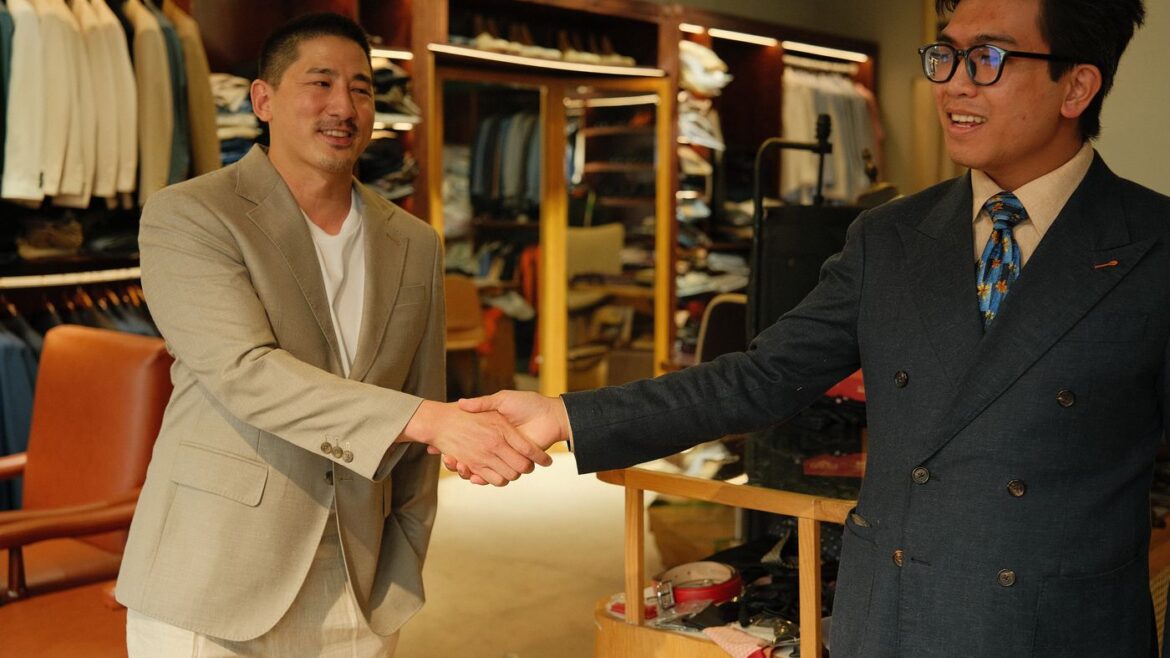
At ManGii, every suit is cut for your body, not a mannequin’s. We measure you in person in Thao Dien, talk about how you stand and how you like a suit to feel, and help you choose cloth, construction and style.
Every order then has two fittings in the shop. At each one we check the shoulders, the collar, the back, the sleeves and the trousers, and change what needs changing. A bespoke suit takes about two weeks, or about three weeks for full canvas.
Our tailoring workshop has run since 2015, and in more than ten years we have dressed 35,000+ clients. After delivery, we keep looking after your suit with lifetime aftercare.
New to all this? Our guide to getting a suit made in Saigon covers cloth, timing and what to bring. Our guide on how a suit should fit has simple checks you can do in the mirror.

Frequently asked questions
Is bespoke always better than made to measure?
Not always. A good made to measure suit can fit very well, and it suits many people and budgets. Bespoke makes the biggest difference when your shape, posture or taste is far from the average.
How many fittings does a bespoke suit need?
At ManGii every order has two fittings. Some traditional bespoke houses use three or more, especially for a first suit.
How long does a bespoke suit take at ManGii?
About two weeks, or about three weeks for full canvas, with two fittings. If you need it sooner, tell us your date and we will see what we can do.
Is a custom suit the same as a bespoke suit?
“Custom suit” is a loose term. It can mean made to measure or bespoke. Ask how the suit is measured, cut and fitted, not just what it is called.
Can I get a bespoke suit if I only visit Saigon for a short time?
Often, yes. Tell us your dates at the first visit and we will plan the two fittings around them. We also ship worldwide.
What does a bespoke suit cost at ManGii?
Two-piece suits start from 7,700,000 VND and three-piece suits from 9,600,000 VND. Two-piece suits in 100% wool start from 16,500,000 VND. The cloth and construction decide the final price.
Feel the difference at a fitting
The easiest way to understand bespoke vs made to measure is to see a suit fitted on your own body. Come in, try on a jacket from our rail, and we will show you what we would change.
Visit us at 31 Xuan Thuy, Thao Dien, open every day from 10am to 7pm, or book a fitting online.